

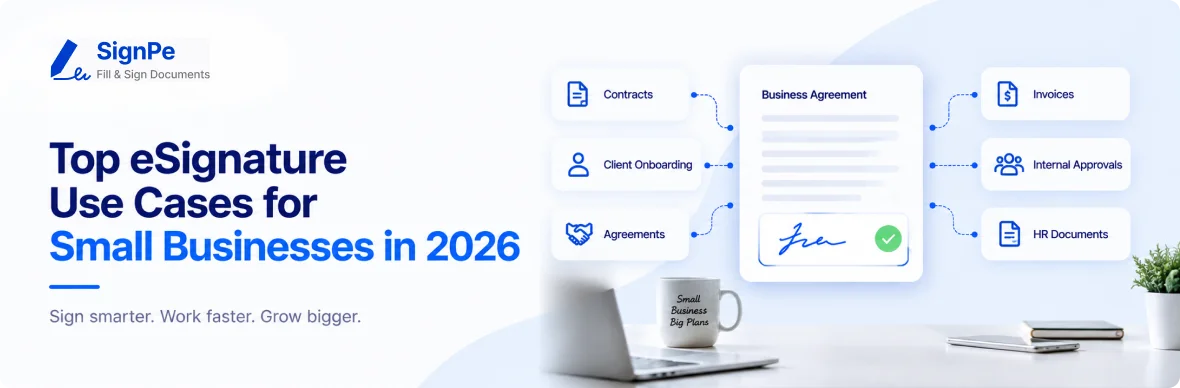
Paper-based signing is not just slow. It costs money in ways most small business owners never fully account for: printing supplies, courier fees, storage space, staff time spent chasing signatures, and the occasional deal that dies while a contract sits in someone’s inbox waiting to be printed.
E-signatures eliminate most of this. But the value is not evenly distributed. Some document types benefit far more than others. Here is where the return is highest for small businesses.
Where Do Small Businesses Waste the Most Time on Paper Signatures?
Sales Contracts
Sales contracts are where slow signing has the most direct commercial cost. Every day a contract sits unsigned is a day the deal can fall apart. A competitor quotes. A decision-maker goes on holiday. The moment passes.
With e-signatures, a contract goes out, gets signed, and comes back in the same working day. Multiple signatories can sign in a set sequence without any party needing to be in the same location. The sales team can track where the document is in the signing process without making a phone call.
Integrations with CRM platforms like Salesforce mean the signed contract updates the deal record automatically.
Client Onboarding Documents
First impressions matter. Asking a new client to print, sign, scan, and email back your onboarding paperwork is a friction point that says something about how your business operates. Not something good.
E-signed onboarding flows can go from “welcome” to fully executed paperwork in minutes. Clients sign on their phone. Documents return automatically. Nothing gets lost, nothing needs chasing.
Non-Disclosure Agreements
NDAs need to happen fast, often at the start of a conversation before any sensitive information changes hands. Paper-based NDA processes create a catch-22: you need the NDA signed before you can discuss the project, but the NDA itself takes days to execute.
An e-signed NDA takes minutes. Upload, assign, send, done. The counterparty signs remotely, the audit trail records everything, and the conversation can start. See how SignPe handles NDA signing workflows for a practical walkthrough.
Vendor and Supplier Agreements
Small businesses working with multiple suppliers spend real time managing paper-based vendor agreements. Purchase orders, supply terms, pricing agreements. Each one requires printing, signing, returning, filing.
E-signatures collapse this into a digital workflow. Documents go out, come back signed, and land in a searchable archive. When a vendor dispute arises, finding the original agreement takes seconds rather than a trip to the filing cabinet.
Employee Onboarding Paperwork
HR onboarding generates a lot of paper. Employment contracts, direct deposit forms, benefits enrolment, tax forms, policy acknowledgements. For a small team, processing this manually for every new hire takes hours.
E-signature workflows let new hires complete everything before their first day. HR staff can see which documents are signed, which are pending, and send automated reminders without making a single phone call. The whole process runs faster with less admin overhead.
New Customer Forms and Consent Documents
For businesses that require customer consent, service agreements, or waivers, paper forms create a compounding problem. Customers forget them, lose them, submit incomplete versions, or require in-person visits purely to sign a form.
E-signatures fix all of this. Send a link. Customer signs. Done. For businesses like health and wellness providers, custom manufacturers, or service firms that collect approval before starting work, this change alone can eliminate hours of administrative back-and-forth per week.
Intellectual Property and Licensing Agreements
IP agreements, licensing terms, and partnership contracts require clear documentation of who agreed to what and when. E-signatures with full audit trails are often stronger evidence than wet ink in this context because they record the exact document version that was agreed to and the verified identity of the signer.
What Types of Small Businesses Benefit Most From E-Signatures?
Which industries see the biggest time savings?
Any business that processes a high volume of recurring documents sees the most immediate return. Recruitment firms, property management companies, accountants, marketing agencies, healthcare practices, and custom manufacturers all deal with regular signing workflows that compound into significant time costs at scale.
Businesses with remote or distributed clients benefit even more. When your clients are in different cities or countries, paper-based signing is not just slow. It is genuinely impractical.
Is eSignature Software Too Complex for Small Teams?
How long does it take to get set up on SignPe?
Creating an account takes a few minutes. Uploading a document, placing signature fields, and sending for signature takes less time than printing and scanning would. Staff need no technical background. Recipients sign without needing an account at all.
The SignPe workflow overview walks through the complete process from document upload to signed return.
Frequently Asked Questions
Are e-signatures legally valid for small business contracts?
Yes. Under the ESIGN Act, UETA, and equivalent laws in most countries, e-signed contracts carry the same legal weight as wet ink signatures. The standard requirements apply: documented consent, attributable signatures, and secure record retention.
What document types should small businesses not e-sign?
Wills, notarised property deeds, court orders, and certain regulated filings still require wet ink in most jurisdictions. For everything else, commercial, HR, vendor, and client-facing documents, e-signatures are appropriate.
How do e-signatures reduce costs for small businesses?
By eliminating printing, scanning, postage, courier costs, and the staff time spent managing those processes. Indirect savings also come from faster deal cycles. A contract that gets signed in hours rather than days reduces the window in which a deal can fall apart.
Can customers sign documents without downloading anything?
Yes. SignPe sends recipients a secure email link. They sign in a browser on any device. No app download, no account creation, no friction.
What happens to signed documents in SignPe?
They are stored in encrypted cloud storage with full audit trail data attached: timestamps, signer identity verification, IP address, and a cryptographic record of the document’s state at signing. Documents are searchable and retrievable on demand.