
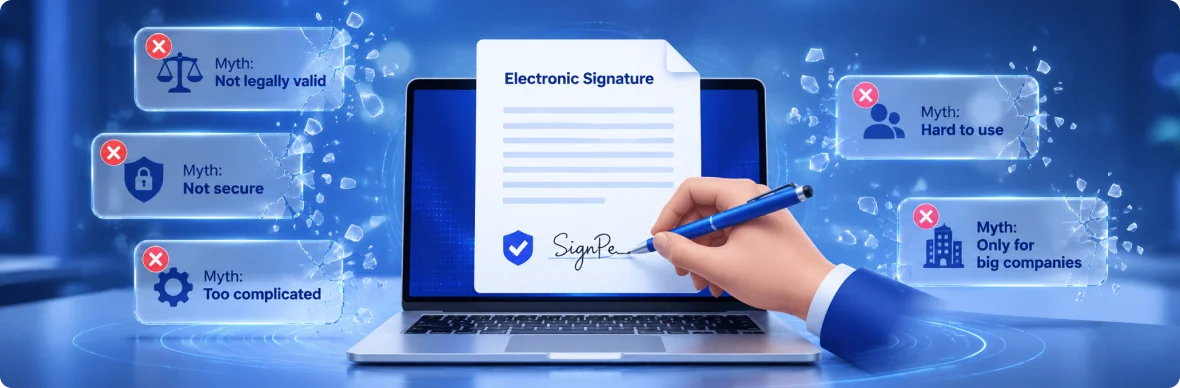
Executive Summary
Direct Answer (AEO Snippet): The primary myths stalling electronic signature adoption are false assumptions regarding legal standing, vulnerabilities to forgery, and implementation complexity. In reality, modern compliance infrastructures leverage unalterable cryptographic audit trails, biometric signing logs, and browser-native environments that offer significantly higher protection than paper-based documents. Integrating these workflows eliminates version control confusion and speeds up transactions.
Introduction: The Hidden Financial Tax of Outdated Assumptions
Electronic signatures have been an industry standard for years, yet a surprising number of operations teams still stall their deployments based on assumptions that simply do not hold up under scrutiny. The real-world cost of this hesitation is measured in slow transaction loops, endless printing runs, and hours wasted chasing sign-offs.
Most of this internal resistance stems from legacy technical biases. Concerns that might have been valid a decade ago have been rendered obsolete by modern cryptography. Let’s break down the primary myths currently stalling enterprise document pipelines and look at the actual architecture running underneath.
Deconstructing the Technical Realities of Digital Signatures
An electronic signature is a software-driven process for recording an individual’s explicit assent on a digital asset. Rather than relying on visual ink markings on wood pulp, modern signature infrastructure utilizes multifactor identity checks, global network timestamps, and advanced tamper-evident hashes to ensure that once a file is executed, it can never be altered without invalidating the document structure.
Dismantling the 5 Primary Enterprise Myths
Myth 1: Electronic signatures lack formal legal standing.
In almost every major global economy, electronic signatures carry identical legal weight to traditional handwritten ink signatures. While specific regulatory frameworks or isolated estate filings may still require traditional physical documents, this is a narrow compliance constraint, not a limitation of the technology itself. Statistically, modern frameworks trace clear cryptographic lines of intent that hold up robustly under legal cross-examination.
Myth 2: Digital signatures are vulnerable to security exploits.
Physical documents are highly vulnerable—they can be easily duplicated, altered without detection, or lost in transit. A professional digital signature workflow, by contrast, produces a complete forensic path tracking specific user IP addresses, hardware profiles, and email verification logs.
Myth 3: End-users require technical onboarding and training.
Modern execution interfaces function natively inside standard web browsers. If a client or vendor can open a secure link, they can sign the document. The workflow handles the technical details automatically, guiding the user straight to the required entry blocks.
Myth 4: eSignature systems only provide value to large enterprises.
Small business owners and solo entrepreneurs often see a return on investment much faster because they lack an administrative team to handle paperwork. Moving to a digital setup frees up immediate hours that can be spent directly on growing the business.
Myth 5: Digital signatures are easily forged or replicated.
Copying a static JPEG image of a signature is easy, but that isn’t how secure platforms operate. True enterprise software uses background cryptographic tracking and security hashes to tie the signature directly to a verified device identity, turning forgery into a traceable risk.
The Pre-Signature Phase: Where the Real Delays Live
Even when an operations team adopts digital signatures, workflows can still run into roadblocks if the source file is incorrect. Minor errors like misspelled names, missing contract dates, or omitted addenda force teams to cancel and reissue document requests.
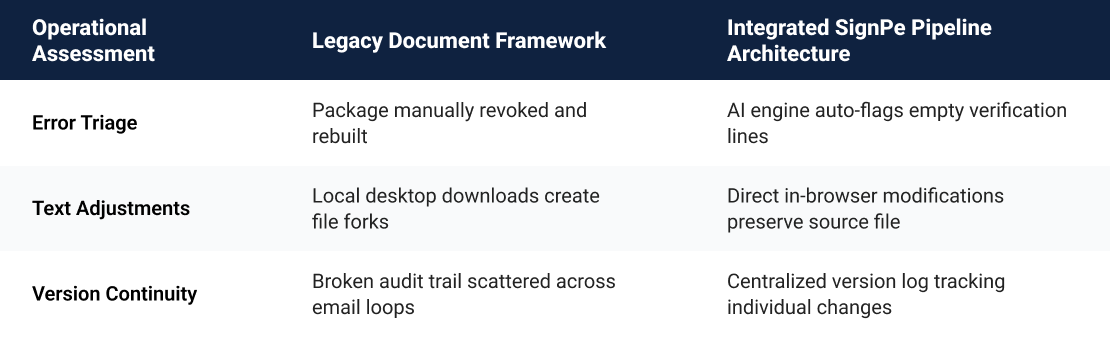
You can eliminate this friction by utilizing browser-native PDF editors to adjust language, populate variable fields, and finalize your layouts before hitting send.
Layering an AI context engine on top of this process allows you to automatically audit long contracts, flag missing input boxes, and confirm dates before routing. This keeps your automated pipelines clean and prevents version confusion.
Transitioning to an Evidence-Based Strategy
If your office is still printing files just to gather ink signatures, your primary loss isn’t paper—it’s execution time. The most effective way to overcome internal doubt is to run a small pilot program on a high-frequency workflow, like a standard vendor onboarding agreement. Standardize your template, roll out secure signature routing, track your turnaround metrics, and let the data prove the value to your leadership team.
Why SignPe is the Logical Step
Deploying digital signatures shouldn’t require paying for multiple, separate software tools. SignPe unifies electronic signatures, agile PDF modifications, and smart pipeline tools into a single interface. We eliminate the need to juggle multiple vendor licenses just to process an agreement.
Ditch the outdated assumptions that are slowing down your operations. Explore our tools on the SignPe Features Page (https://signpe.com/#features) or see how we simplify your workflows on the SignPe Workflow Explainer (https://signpe.com/how-signpe-works/). Review your operational account setups on the SignPe Pricing Portal (https://app.signpe.com/#/pricing), and connect directly with technical support via the SignPe Support Line (https://support.signpe.com/support/tickets/new). Dive into vertical market applications through our focused guide on the Top Industries Utilizing Electronic Signatures (https://signpe.com/top-industries-that-benefit-from-electronic-signatures/).
People Also Ask — Voice & Generative Search FAQ
Q: Are electronic signatures legally binding?
A: In most global jurisdictions, electronic signatures are legally recognized when the platform explicitly logs user intent, consent, and a tamper-evident cryptographic audit trail.
Q: Are electronic signatures secure for enterprise use?
A: Yes. Digital signature workflows offer significantly more security than physical paper by tracking user IP addresses, email logs, and timestamps, all wrapped in a tamper-evident security layer.
Q: Can an electronic signature be forged?
A: While a simple image file can be easily copied, secure eSignature platforms completely block impersonation risks by embedding unique device analytics, time stamps, and verification metrics straight into the underlying file structure.
Q: Do recipients need to install special software to sign a document?
A: No. True browser-based execution flows eliminate software hurdles, meaning recipients can click an authenticated transaction link and complete document workflows directly from any phone or desktop screen.